Grand Egyptian Museum (GEM)
At the edge of the Giza Plateau, the Grand Egyptian Museum feels less like a sealed container and more like a threshold between desert, pyramid, and gallery. Designed by heneghan peng architects, the 500,000 sq m complex uses sharp geometry, filtered daylight, and ceremonial scale to echo ancient Egypt without copying it directly. You move through it as much as you look at it: past a suspended obelisk, into a vast hall anchored by Ramses II, and upward through processional spaces that steadily build drama. Understanding the building changes the visit, because here, the architecture is part of the exhibition.
{jumplink target="Quick overview of the architecture of Grand Egyptian Museum" text="Quick overview"}
{jumplink target="Architectural style(s) & influences" text="Styles & influences"}
{jumplink target="Architectural highlights of Grand Egyptian Museum" text="Highlights"}
{jumplink target="9. Who designed/built Grand Egyptian Museum?" text="Who designed it?"}
{jumplink target="History of Grand Egyptian Museum’s architecture / Stages of construction" text="History"}
{jumplink target="The exterior of Grand Egyptian Museum" text="Exterior"}
{jumplink target="The interior of Grand Egyptian Museum" text="Interior"}
{jumplink target="Best Grand Egyptian Museum tickets & tours to explore Grand Egyptian Museum architecture" text="Tickets & tours"}
{jumplink target="Frequently asked questions about Grand Egyptian Museum’s architecture" text="FAQs"}
Grand Egyptian Museum (GEM)
Giza Plateau, Greater Cairo, about 2km from the Pyramids of Giza
Archaeological museum
2002
2003
Phased opening from 2024, with major galleries open by 2025
500,000 sq m (5.4 million sq ft)
Contemporary monumental design with Egyptian geometric influences
heneghan peng architects
Widely described as the world’s largest museum dedicated to a single civilization
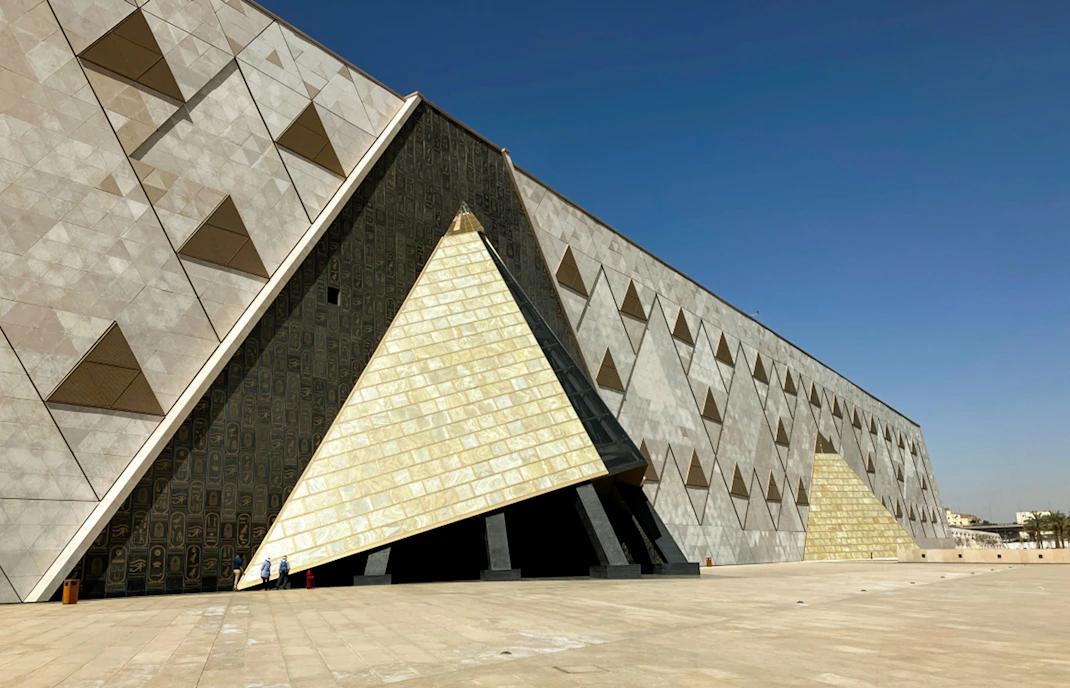
The museum’s architecture is best understood as Contemporary monumental design with Egyptian references. ‘Contemporary’ means it uses modern engineering, large uninterrupted interiors, and abstract forms rather than historical imitation. Instead of recreating an ancient temple, the design borrows from Egypt through geometry, massing, and orientation — especially the way its angular lines and long sightlines speak to the nearby pyramids.
There is also a strong ceremonial quality to the building. Like an ancient processional route, the sequence from forecourt to hall to staircase is choreographed to slow you down and direct your gaze. Compared with the older Egyptian Museum in Tahrir, which feels urban and 19th-century, this complex feels landscape-driven, open, and intentionally cinematic. Visitors spot these influences most clearly in the faceted stone façade, the desert-facing plazas, and the carefully framed views outward.
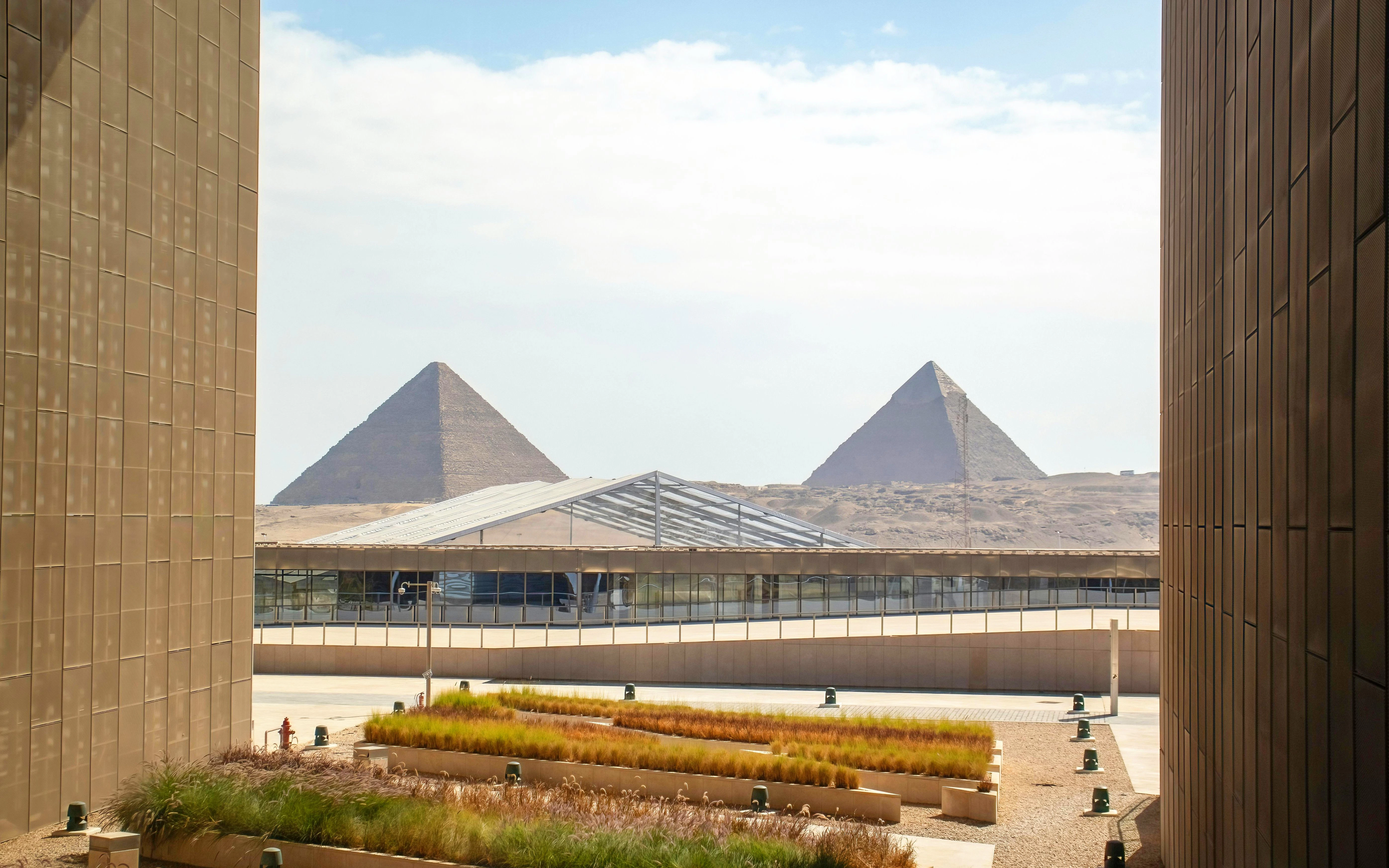
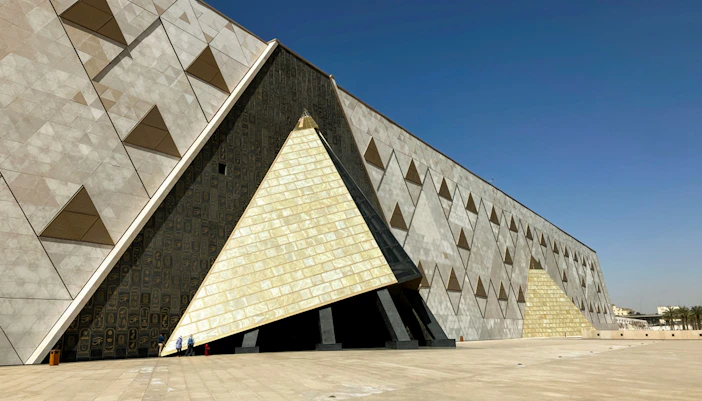
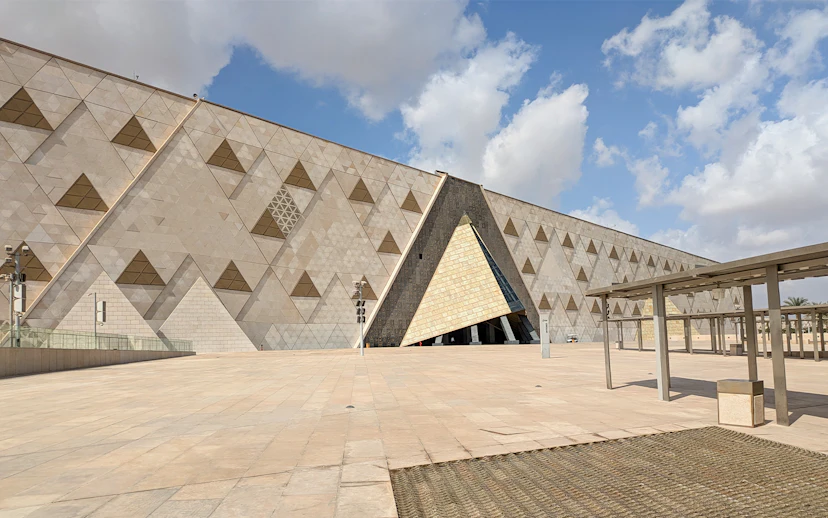
Wide exterior view of the museum’s angular stone façade rising from the desert edge, with the Giza Plateau beyond.
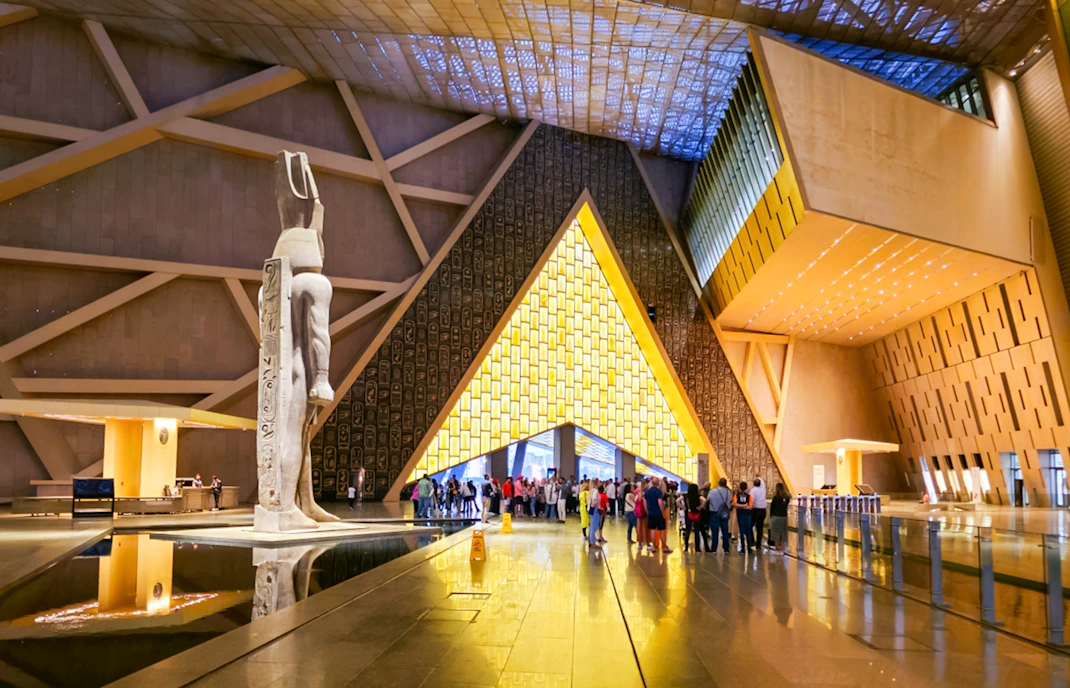
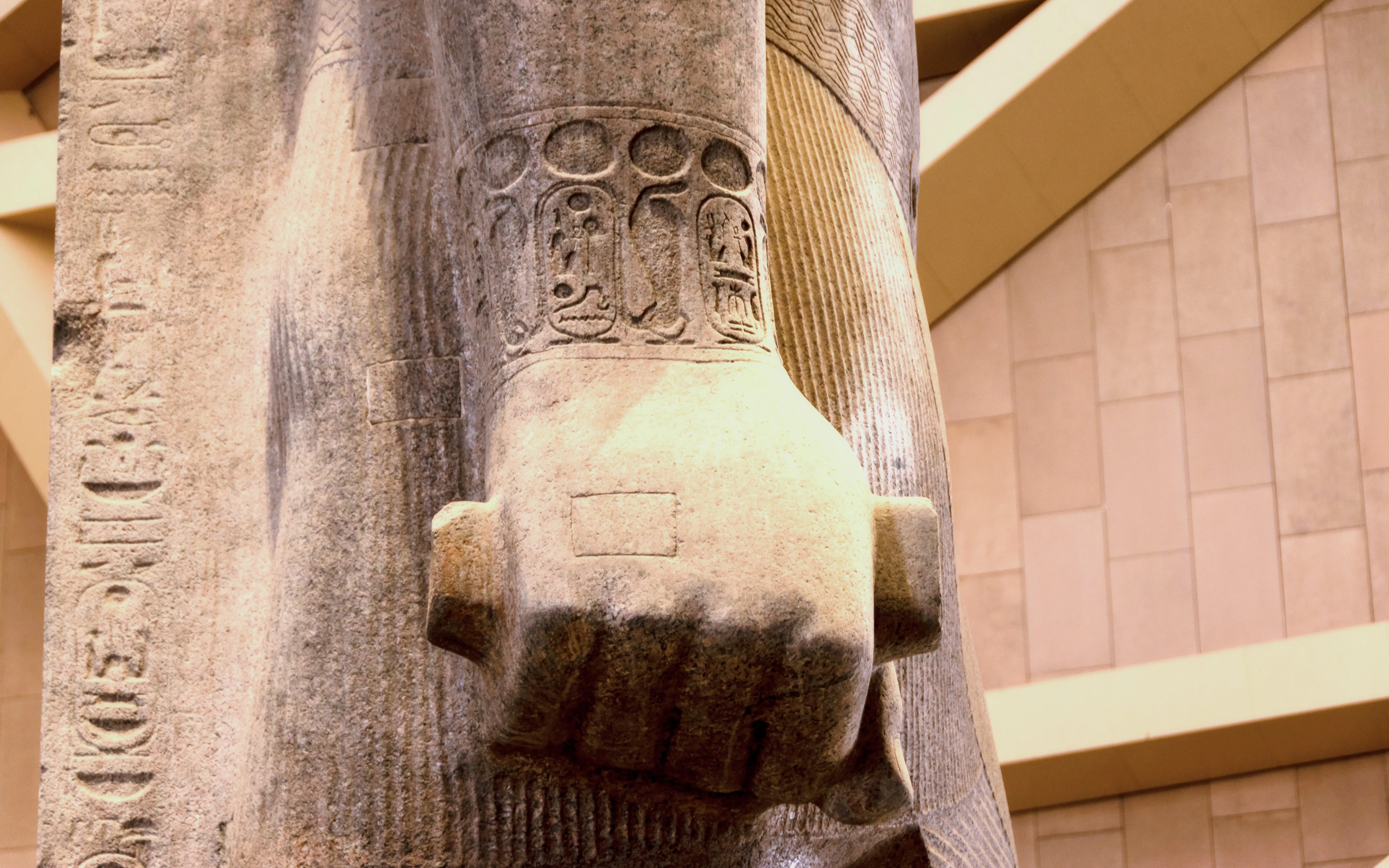
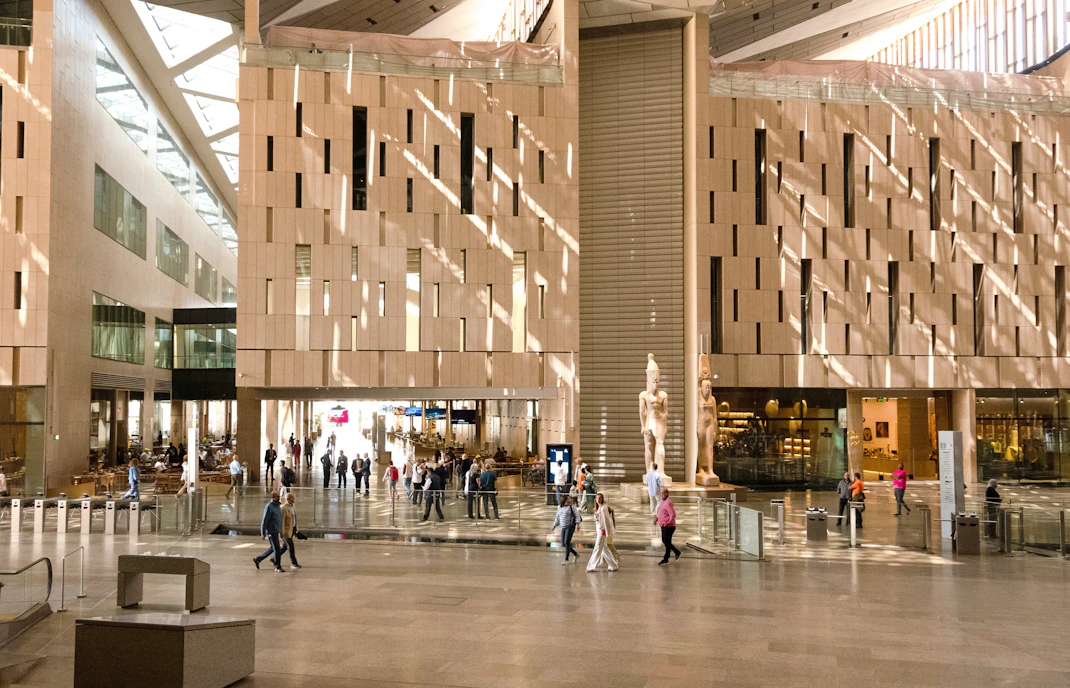
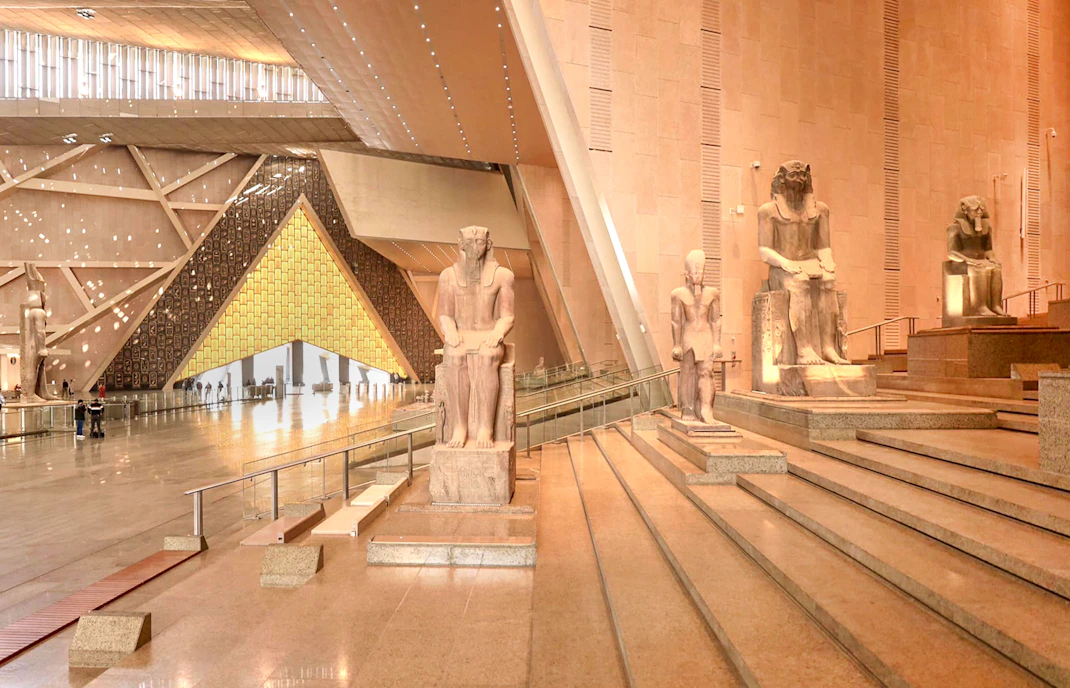
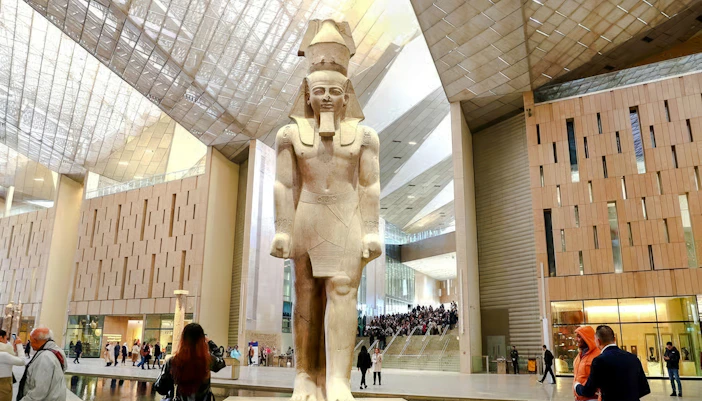
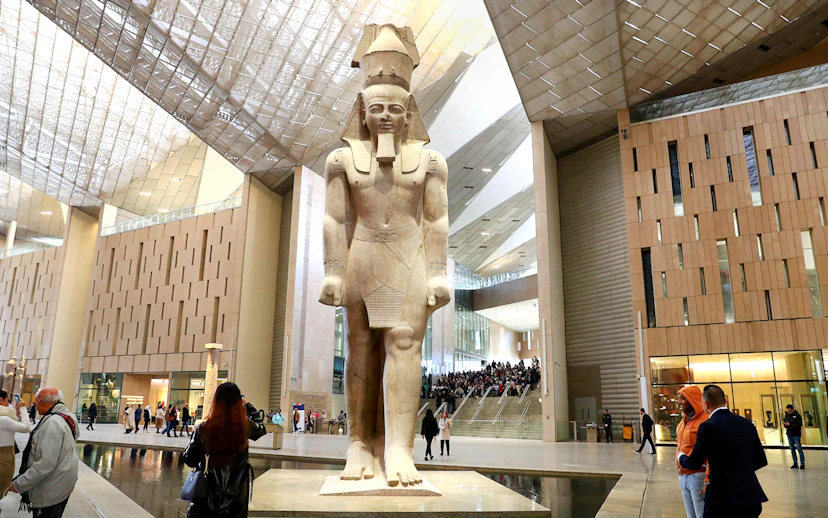
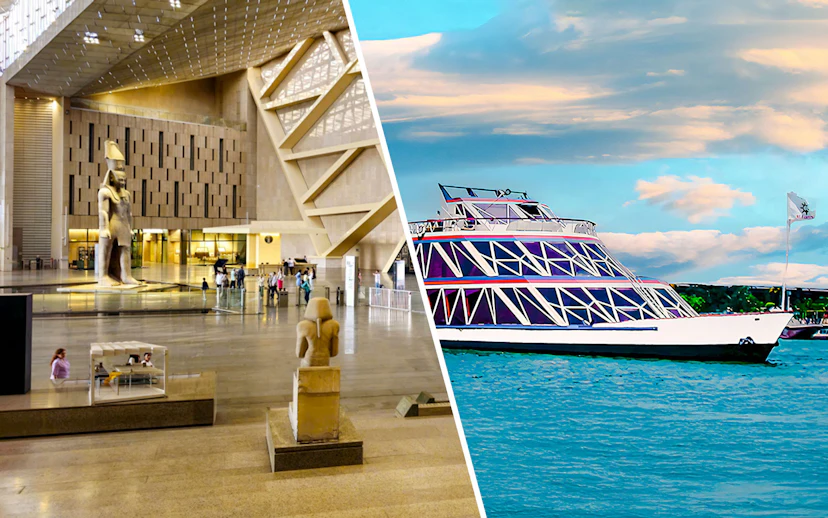
Ramses II statue in the Grand Hall beneath the high roof, with the Grand Staircase receding behind it.

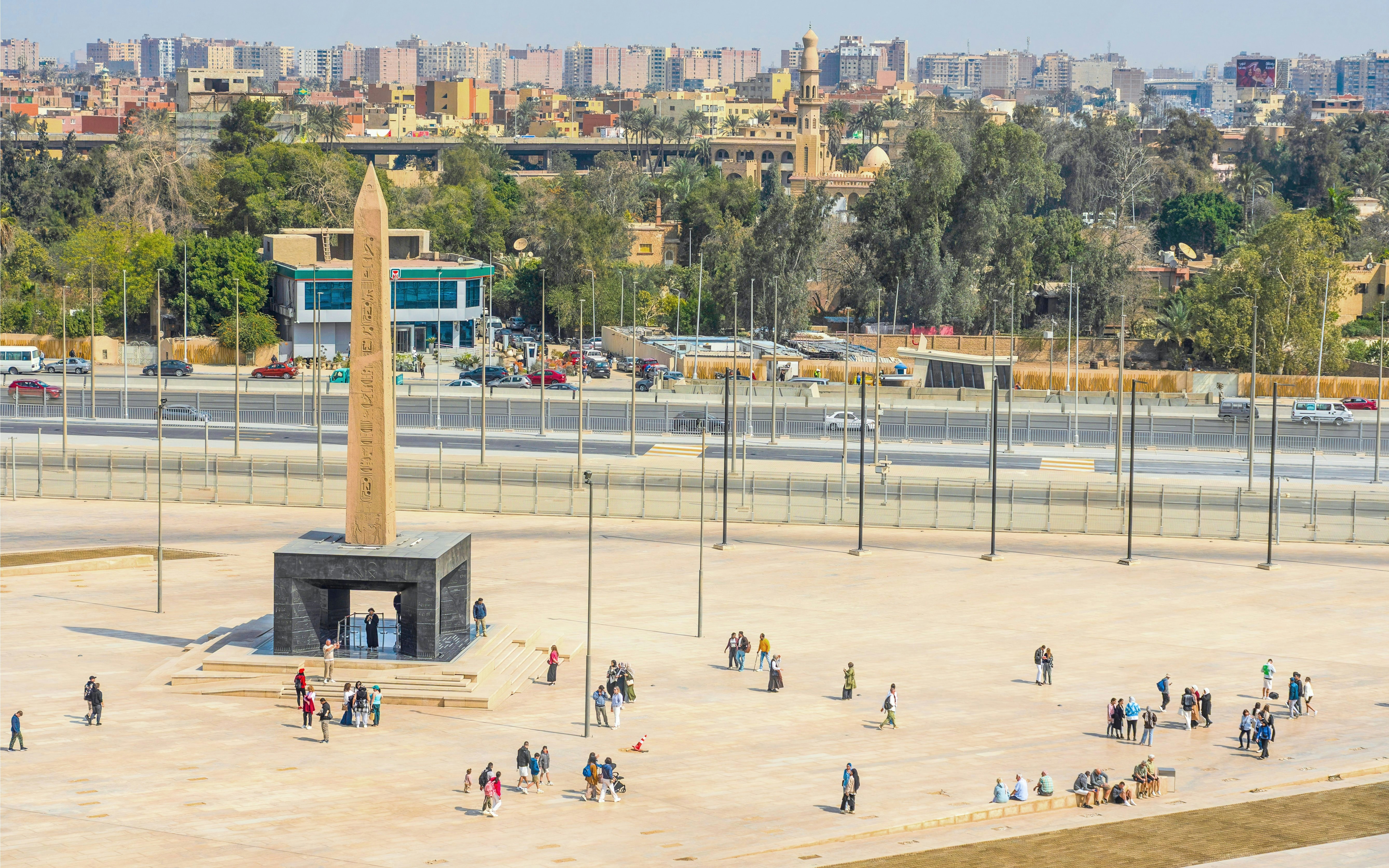
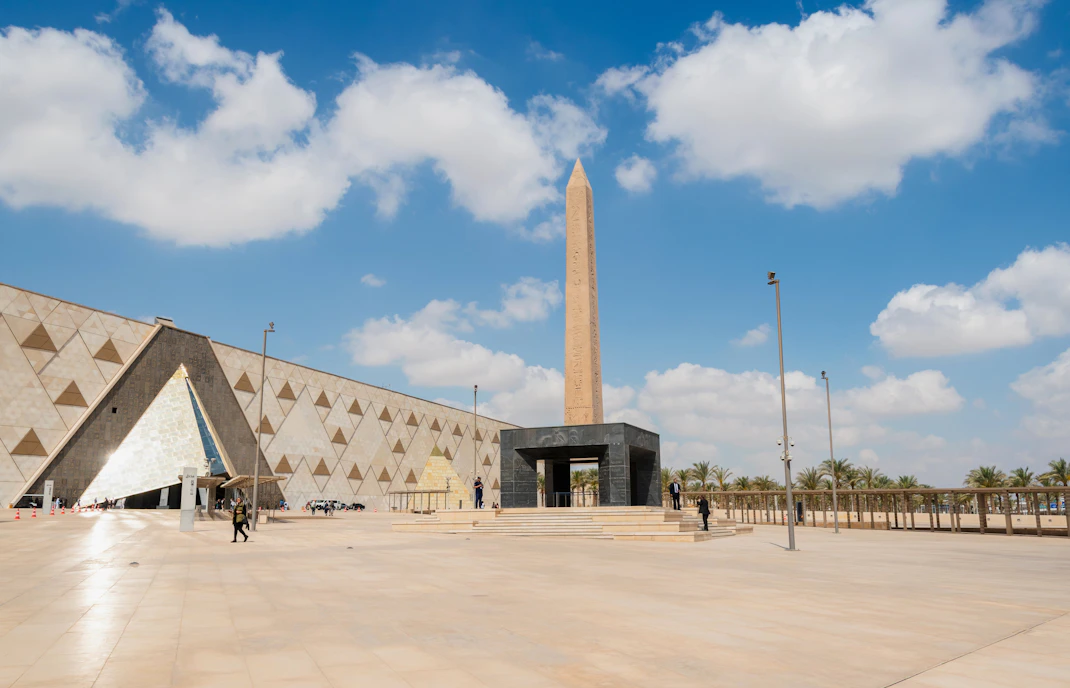
A 27m obelisk of Ramses II is suspended above a glass platform, turning the entrance court into a feat of structural theater before you even step inside.


The Dublin-based practice won the international design competition in 2003. Their concept treats the museum as a sequence of stone, light, and monumental movement, with geometry that acknowledges the Giza Plateau.
The museum was commissioned by Egypt’s antiquities authorities and delivered over many years with large-scale engineering, conservation, and exhibition teams. Their contribution turned a competition-winning concept into a working national museum of exceptional scale.
Competition and concept
The project was launched in 2002, and an international competition selected heneghan peng architects in 2003. From the start, the ambition was unusually large: to create a museum that could match the symbolic weight of ancient Egypt while standing beside the pyramids without imitating them literally.
Construction and delay
Building a 500,000 sq m museum near one of the world’s most sensitive archaeological landscapes was never a simple exercise. Construction extended across many years, shaped by funding pressures, political disruption, and the technical demands of creating vast galleries, conservation spaces, and public circulation routes on a desert-edge site.
Phased opening and operational refinement
Rather than opening all at once, the museum entered public life in stages. That phased rollout allowed teams to test visitor flow, install major displays, and refine the relationship between architecture and exhibition design. Today, the building reads as both a finished monument and a living institution still adjusting how people move through it.
Read more about the history of the Grand Egyptian Museum.
From a distance, the museum reads as a low, monumental landform rather than a traditional civic façade. Its angular profile, broad forecourts, and faceted stone skin give it a desert weight that feels appropriate to Giza. As you approach, the geometry becomes sharper: long planes, deeply cut edges, and carefully staged open space prepare you for an arrival that is ceremonial rather than abrupt.
Up close, the exterior is less about ornament than about control of scale. The Hanging Obelisk provides the key dramatic moment, but the real achievement is how the building frames movement, sky, and horizon. Because the complex is contemporary, conservation here is less about repairing historic fabric and more about maintaining finishes, managing heat and light exposure, and fine-tuning circulation across a very large site. Arriving in the early morning or late afternoon gives you the clearest reading of its mass, texture, and desert setting.
The Grand Hall is the museum’s first major architectural zone, and it works as an orientation chamber. The ceiling height, filtered light, and placement of Ramses II immediately set the scale of the visit. This is where you understand that the building is designed to feel processional, not compact. If you want the cleanest first impression, try to enter close to opening, before the central space fills.
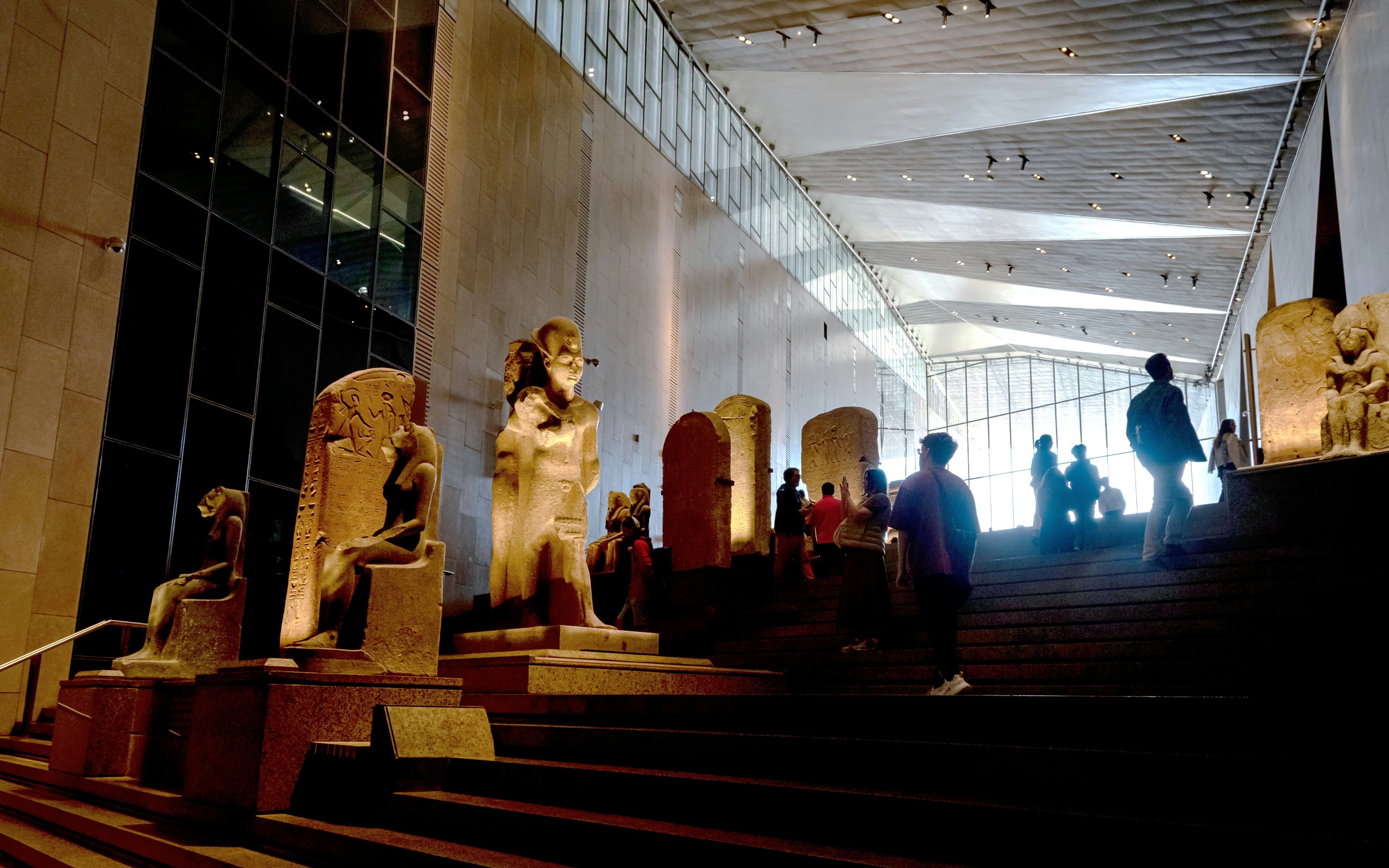
The Grand Staircase is the emotional core of the interior. It is a circulation device, but it also behaves like an exhibit spine, using elevation, sculpture, and long sightlines to guide you upward. Mid-landing pauses are especially rewarding because they give you backward views into the hall and forward views into upper-level zones.
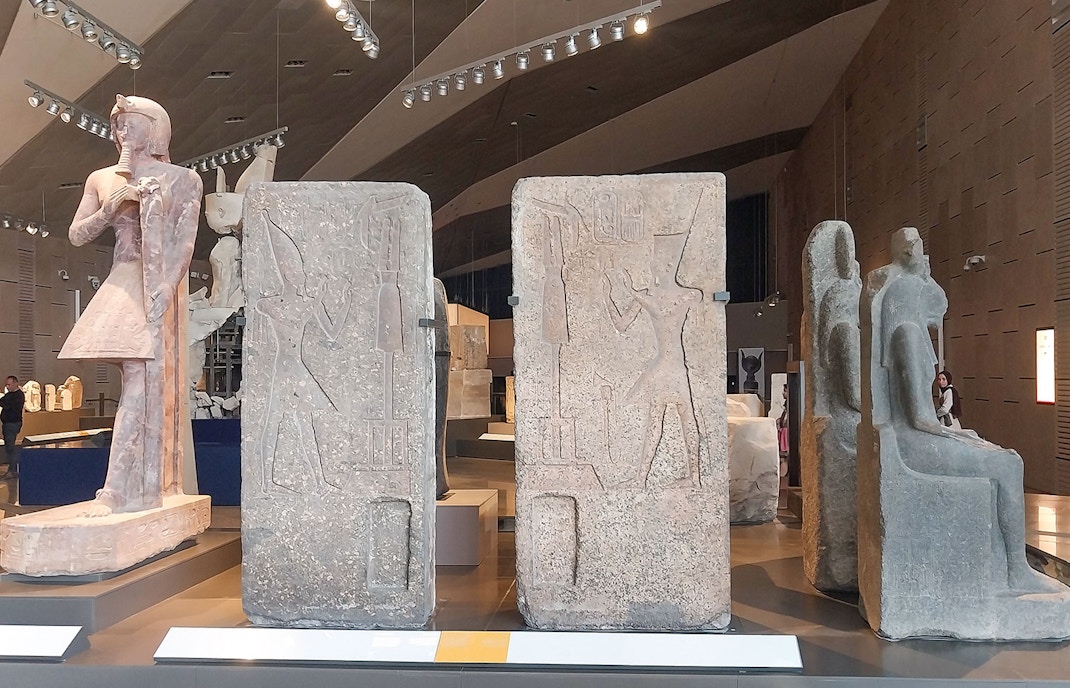
The main galleries and viewing edges are more controlled and intimate. Lighting is calmer, object spacing is generous, and routes are clearer than in many older museums. For an architecture-first route, move from the entrance court to the Grand Hall, then the Grand Staircase, upper galleries, and finally the outward-facing terrace views. Discover more in this guide to what’s inside the Grand Egyptian Museum.
Its defining features are monumental geometry, a faceted stone exterior, the Hanging Obelisk, the Grand Hall with Ramses II, the Grand Staircase, and long sightlines toward Giza. The design uses procession, scale, and controlled light to make movement through the museum feel ceremonial.
No. The older Egyptian Museum in Tahrir is far closer to a 19th-century museum language, while the Grand Egyptian Museum is contemporary and abstract. It refers to ancient Egypt through massing, alignment, and atmosphere rather than columns, pediments, or historical imitation.
The museum was designed by heneghan peng architects after an international competition. The final concept was shaped by the desert site, the nearby pyramids, the need for very large galleries, and the desire to create a national museum that feels both modern and unmistakably Egyptian.
The museum is organized around a strong arrival sequence: entrance court, Grand Hall, Grand Staircase, and then the main galleries. This makes wayfinding more intuitive than in many older museums. If you’re planning your route, start with the central spaces before branching into the galleries.
Don’t skip the view from beneath the Hanging Obelisk, the frontal approach to Ramses II in the Grand Hall, and the mid-landings of the Grand Staircase. Terrace edges and outward-facing points are also worth seeking out, especially later in the day when the exterior light softens.
The museum’s generous scale helps with visibility and flow, and current visitor information indicates wheelchair and stroller accessibility. Elevators, broad circulation areas, and clear sightlines make it easier to navigate than many historic museums, although the overall footprint means comfortable shoes still matter.
Yes — mostly through phased opening and operational refinement rather than major architectural rebuilding. As galleries, services, and interpretation systems came online, circulation patterns were tested and adjusted. That means your experience today is shaped by both the original design and its real-world use.
Please take note of the timings below:
Inclusions #
Skip-the-line entry to the Grand Egyptian Museum
Access to all main galleries
Access to Tutankhamun’s galleries
Access to King Khufu's Boat
Round trip hotel transfers (based on option selected)
Guided tour in English or Arabic (based on selected option)
GEM Discovery Challenge (based on selected option)
Traditional Egyptian lunch (based on option selected)
Giza Complex
Grand Egyptian Museum
Giza Complex
Grand Egyptian Museum
Giza Complex
Grand Egyptian Museum
Please take note of the timings below:
Inclusions #
Giza Complex
Grand Egyptian Museum
Inclusions #
Full-day tour of the Giza Complex+ Grand Egyptian Museum + Khan El-Khalili Bazaar
Entry to Pyramids of Giza, Sphinx, & Grand Egyptian Museum
Visit to Khan el-Khalili Bazaar
Shared or private hotel transfers in an A/C vehicle (based on option selected)
Multilingual guide (English, Arabic, German, French, Italian, and Spanish)
Traditional Egyptian lunch
Bottled water
Exclusions #
Great Pyramid of Khufu entry ticket (can be purchased on site)
Tips
Drinks at the restaurant
Inclusions #
Entry to the Grand Egyptian Museum
Multilingual guided tour (English/French/German/Italian/Spanish)
Shared or private round-trip hotel transfers from Cairo or Giza (based on option selected)
Access to all main galleries
Access to Tutankhamun’s galleries
Access to King Khufu's Boat
Traditional Egyptian lunch (based on selected option)
Exclusions #
Gratuities
Personal expenses
Direct entry with private hotel transfers for a stress-free Grand Egyptian Museum visit
Inclusions #
Skip-the-line entry to the Grand Egyptian Museum
Access to 12 galleries
Private one-way or round-trip transfers in an air-conditioned vehicle (as per option selected)